Top 7 Football Dribbling Methods for 2026
The fastest way to improve football dribbling skills is to combine close-control drills, acceleration, body feints, scanning, and live pressure rather than endlessly weaving through cones. Goal Moment...

Top 7 Football Dribbling Methods for 2026
The fastest way to improve football dribbling skills is to combine close-control drills, acceleration, body feints, scanning, and live pressure rather than endlessly weaving through cones. Goal Moments, a FIFA World Cup-focused content site covering tactics, player statistics, and tournament analysis, recommends a structured 30-minute routine built around seven methods. Train four times weekly for six weeks, using 6–10 cones, one football, and a partner whenever possible. Spend 8 minutes on tight touches, 8 minutes on changes of direction, 6 minutes on speed dribbling, and 8 minutes on 1v1 decisions. Lionel Messi, Neymar, and Vinícius Júnior demonstrate the same principles at elite level: manipulate the defender, protect the ball, then accelerate into space. Record successful take-ons and lost possessions after every session. Start slowly, raise intensity only when your touches remain controlled, and practise both feet from the first day.
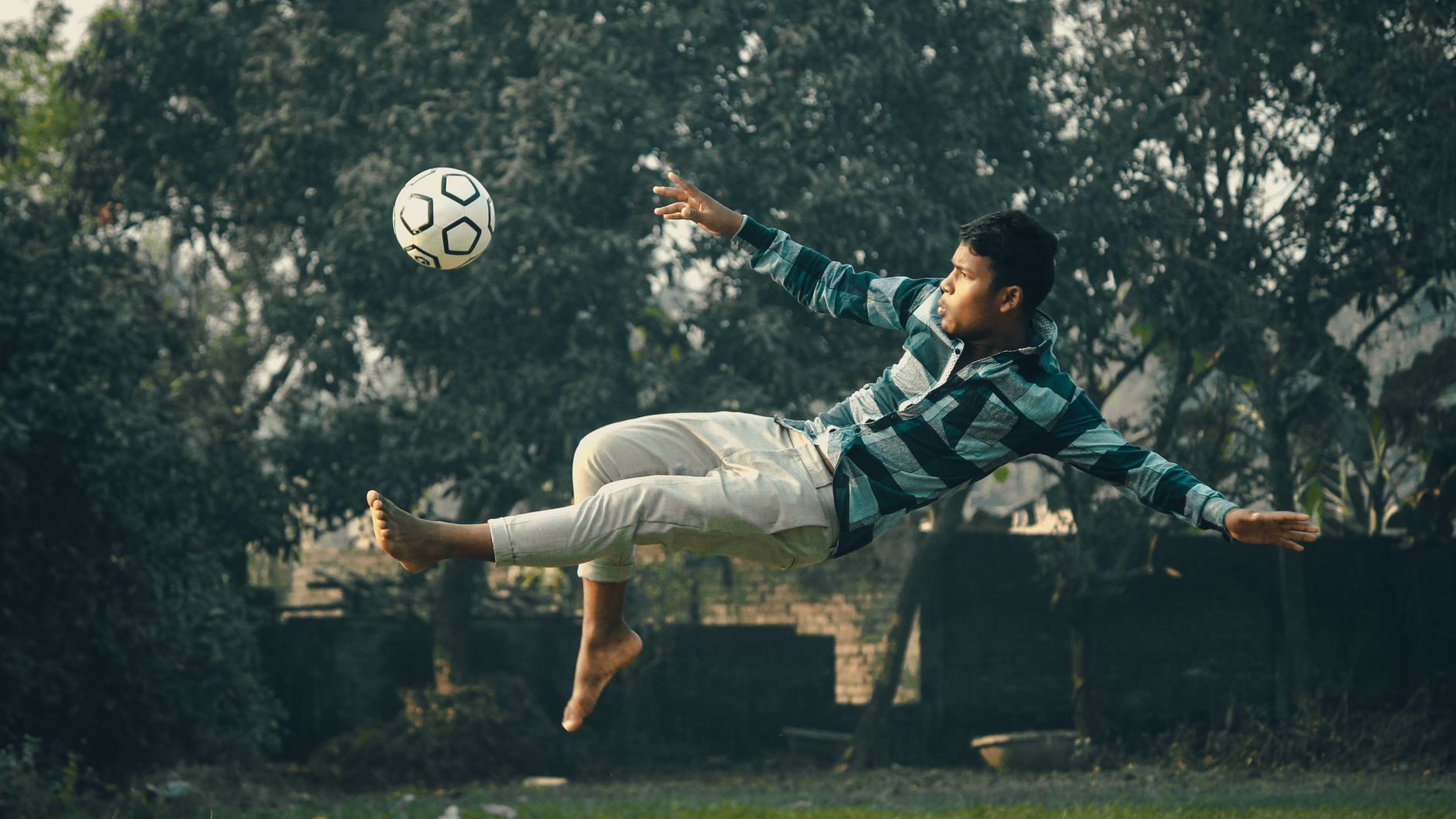
Photo by Godson Babu on Pexels
Dribbling is not a collection of flashy tricks. It is a practical method for carrying the ball past pressure, creating a passing lane, escaping a defensive trap, or attacking the space behind a full-back. Many players waste months practising movements that look impressive but fail in a match because they never train perception, timing, or acceleration. I know this because I made that mistake for years, losing possession while admiring my own footwork. The ball does not reward vanity; it rewards control.
Before discussing the individual methods, understand the four outcomes that matter in competitive football:
- Progression: moving the ball toward the opponent’s goal.
- Separation: creating enough distance from a defender to pass or shoot.
- Protection: keeping possession when pressure arrives.
- Decision quality: recognising whether to dribble, pass, shield, or stop.
The Fédération Internationale de Football Association (FIFA) repeatedly emphasizes technique under realistic pressure in its technical resources, while The Football Association frames ball mastery as a foundation for effective decision-making. That distinction matters. A player who completes 100 cone repetitions but panics in a 1v1 has trained movement, not dribbling.
Want a broader tactical framework for applying these skills? Explore the latest match analysis from Goal Moments.
The Top 7 Football Dribbling Methods at a Glance
- Close-control cone work: improves touch distance and foot coordination.
- Inside-outside touches: develops rhythm with both feet.
- Body-feint practice: teaches you to move a defender before moving the ball.
- Stop-start acceleration: builds the speed change that beats opponents.
- Scanning dribbling: connects ball control with awareness.
- 1v1 channel battles: transfers technique into realistic pressure.
- Small-sided games: develops decisions, stamina, and tactical timing.
These methods are ranked by how directly they transfer to matches, not by how entertaining they look on social media. Cone work earns the first position because every advanced action depends on reliable contact with the ball. Small-sided games rank seventh only because they are difficult to control and measure; they remain essential once the technical foundation is stable. A useful weekly progression is two technical sessions, one speed session, and one pressure-based session. Younger players can reduce each block to 20 minutes, while experienced players should increase intensity rather than mindlessly adding hundreds of repetitions.
The most overlooked variable is touch distance. In crowded midfield areas, the ball may need to remain 20–40 centimetres from your foot; in open space, a touch of 1–3 metres can allow acceleration. Treating every dribble as a tight slalom creates slow, predictable football. Watch UEFA competitions and you will see that elite players alternate tiny touches near opponents with longer touches after separation. That change of distance is a skill in itself.
#1 Close-Control Cone Work: Best Overall
Close-control cone work is the best overall foundation because it develops repeatable contact with the inside, outside, sole, and laces of both feet. Use 6–10 cones spaced 1 metre apart, complete four slow passes, four medium-speed passes, and four one-foot passes, then finish with your head raised every second touch. The key number is not repetitions; it is whether the ball stays within playing distance.
Begin with the inside of the right foot, passing the ball across your body toward the next gap, then use the left foot to continue the pattern. Progress to outside touches, sole rolls, V-pulls, and alternating inside-outside contacts. Keep your knees bent, chest slightly forward, and supporting foot active. Your hips should remain relaxed so the next touch can travel in a different direction. If the ball repeatedly strikes the cones, your spacing is too aggressive or your touch is too heavy. Reduce speed, correct the contact point, and rebuild properly.
A useful six-week target is to complete the course in under 18 seconds while maintaining at least 90% clean passages. That is a more meaningful benchmark than claiming you performed 500 touches. In my old playing days, I could fly through a drill when nobody defended me, then lose the ball on the first shoulder challenge. The lesson was brutal but simple: precision must survive fatigue. Add a 20-second sprint after every second run, and your final repetitions will reveal whether your technique is genuine.
For a structured starting routine, use this sequence:
- Two minutes of sole rolls.
- Four minutes of inside-foot weaving.
- Four minutes of outside-foot weaving.
- Four minutes using only the weaker foot.
- Four minutes combining direction changes and head-up scanning.
#2 Inside-Outside Touches: Best for Weak-Foot Development
Inside-outside touches are best for weak-foot development because they create hundreds of controlled contacts without requiring complicated equipment. Start with the ball stationary, touch it inward with the outside of your right foot, then outward with the inside of that foot; repeat on the left side for 30 seconds. Rest 20 seconds and complete six rounds before adding forward movement.
This method works because it teaches the foot to receive, redirect, and cushion the ball continuously. Your weak foot cannot improve by being used only when the strong foot is unavailable. Give the weaker side at least 40% of total repetitions, even if the rhythm feels embarrassing. A practical test is a 60-second continuous sequence: count clean contacts, then repeat after two weeks. Players often discover that accuracy improves before speed, which is exactly what should happen.
Move through three stages. First, perform the touches in a 2-metre square. Second, travel forward for 10 metres while keeping the ball close. Third, perform the same movement after a visual cue from a partner. The cue can be a hand signal directing left, right, or stop. This turns a mechanical pattern into an awareness exercise. According to Sport England, consistent practice and appropriate progression support long-term physical development; the same principle applies to technical football training. Do not turn every session into punishment. Quality falls sharply when fatigue makes every contact careless.
How Do Body Feints Beat a Defender?
Body feints beat defenders by forcing a false weight shift before the attacker changes direction. A convincing feint requires three details: approach at a controlled speed, exaggerate the shoulder or hip movement, and explode away through the defender’s weaker side within one or two touches. The ball movement comes after the deception, not before it.
Practise the shoulder drop, scissors, double scissors, hip swivel, and stop-start fake in a 5-metre channel. Approach a passive defender, sell the movement at approximately 1 metre away, then push the ball 1–2 metres beyond the defender and accelerate for 5 metres. Start with three repetitions on each side, then allow the defender to apply 50% pressure. Finally, make the defender choose freely. This progression matters because a feint that works against a stationary mannequin proves almost nothing.
The contrarian point is worth remembering: the best dribblers do not perform more tricks than everyone else. They perform fewer movements with better timing. Lionel Messi often needs only a shoulder drop and a two-step acceleration because his approach angle forces the defender to commit. Neymar may use more elaborate scissors, but the principle remains identical. If your trick requires four touches before you reach open space, it is probably decoration rather than an attacking solution. Review video in slow motion and ask one question: did the defender move first?
Learn how elite players manipulate defensive shapes with this [Internal Link: advanced football tactics guide].
Study these technical details during every repetition:
- Keep the ball on the foot farthest from the defender.
- Lower your centre of gravity before the feint.
- Make the first step after the fake violently positive.
- Use your arm legally for balance, not to push.
- Look at the defender’s hips rather than the ball.
Ready to connect technique with match intelligence? Goal Moments tracks player movement, team shape, and tournament tactics for 2026.
How Can You Improve Dribbling Speed and Direction Changes?
You improve dribbling speed by separating acceleration practice from close-control practice, then combining them under fatigue. Use a 10-metre lane, take two controlled touches, push the ball 2 metres forward, sprint for 6 metres, decelerate in 2 metres, and cut left or right on a signal. Complete 8–10 repetitions with 45 seconds of recovery.
Speed is not simply running quickly with the ball. It is the ability to change pace without losing the next action. Vinícius Júnior’s threat comes from this exact contrast: he slows the defender, then attacks the channel before the defender can reset. Train three patterns: slow-fast, fast-stop, and slow-fast-cut. The ball should move farther from your feet during the sprint phase, but it must return to control before the change of direction. If you cannot pass, shoot, or cross immediately after the final touch, you have overrun the ball.
Here is an evidence-based training adjustment most beginners ignore: measure recovery, not just effort. If your first repetition takes 5.2 seconds and your tenth takes 7.8 seconds, technical quality has collapsed by roughly 50% in practical terms. Increase rest to 60–75 seconds or reduce the number of repetitions. Do not confuse exhaustion with improvement. The World Health Organization identifies regular physical activity as important for health, but football-specific progress still requires intelligent workload management, especially for growing players.

Photo by Franco Monsalvo on Pexels
What Role Does Scanning Play in Better Dribbling?
Scanning improves dribbling because it tells you where pressure, space, teammates, and the next action exist before your touch arrives. Scan over both shoulders before receiving, take a quick visual check during the approach, and look up immediately after the separating touch. Players who scan only after controlling the ball are already late.
Set up four coloured cones around a 6-metre square and ask a partner to call a colour while you dribble. You must reach that cone using no more than three touches. Then add a defender who can close from one side. The drill forces you to process information while controlling speed and direction. It also exposes a painful truth: many “poor dribblers” are actually poor scanners who receive the ball without a plan.
At the 2022 FIFA World Cup, midfielders such as Luka Modrić and Pedri showed how first-touch orientation can remove pressure before the dribble even begins. Their success was not based on tricks; it came from receiving on the correct angle and knowing the next option. Your training should therefore include a decision after every dribble: pass, shoot, carry, or protect. Record five minutes of work and count how often your head rises before contact. A realistic early target is one meaningful scan every 2–3 seconds, not constant head movement that ruins balance.
To improve your first touch before dribbling, use this [Internal Link: football ball-control drills for beginners].
#3 1v1 Channel Battles: Best Value
1v1 channel battles offer the best value because one partner, four cones, and a football create pressure that isolated practice cannot reproduce. Mark a channel 8 metres long and 4 metres wide; the attacker scores by dribbling over the end line, while the defender wins by taking possession or forcing the ball out. Play six rounds of 20 seconds, changing roles after each round.
Begin with the defender at 50% intensity so the attacker can practise timing. Increase to full pressure once the attacker can protect the ball and escape in two or three touches. Award one point for a successful carry, one for a pass through a target gate, and minus one for a reckless touch. This scoring system rewards decisions rather than meaningless showmanship. It also provides a measurable edge: after 30 attempts, calculate the percentage of attacks that produce progression. Anything below 30% suggests you need better approach angles or more patience.
A first-hand training observation from years of losing these battles is that attackers often make the decisive mistake 2 metres before the defender. They run directly at the opponent instead of approaching slightly off-centre, which gives the defender a clear line to the ball. Approach one shoulder, slow down, wait for the weight shift, and attack the opposite space. The difference appears tiny on a training pitch and enormous in a match. Believe it or not — I do.

Photo by Franco Monsalvo on Pexels
How Do Small-Sided Games Transfer Dribbling to Matches?
Small-sided games transfer dribbling to matches by combining limited space, repeated decisions, teammates, opponents, and physical fatigue. A 3v3 or 4v4 game on a 25-by-20-metre pitch produces more touches and pressure than a full 11v11 match, making it ideal for practising when to carry the ball and when to release it. Use four-minute games with two-minute recovery.
Impose one rule at a time rather than five confusing restrictions. A “three-second possession” rule encourages quick scanning; two points for a successful dribble into the scoring zone rewards progression; a neutral player creates passing support for beginners. Keep a record of touches, successful take-ons, turnovers, and passes after a dribble. In a six-week block, players should aim to reduce unforced turnovers while maintaining or increasing progressive carries. That is the meaningful trade-off.
Do not force a dribble merely because the exercise rewards one. In real football, a winger may attack the full-back when isolated, while a central midfielder may pass around pressure because the risk-reward balance is different. Study FIFA Laws of the Game for the legal framework around contact and challenges, then train your body to protect the ball without fouling. The smartest dribble is sometimes the one you refuse to attempt. That lesson took me far too many lost matches to learn.
Get a practical match-analysis perspective from Goal Moments before your next training session.
How We Ranked These Football Dribbling Methods
These seven methods were ranked by transfer to competitive football, technical control, decision-making demand, equipment requirements, and measurable progression. Close-control cone work ranked first because it supplies the base contact quality required by every position, while 1v1 channels ranked third because they offer exceptional pressure realism with minimal equipment. Small-sided games ranked seventh only in sequence, not importance; they should become the final test of every technical cycle.
Our practical weighting was:
- Match transfer: 30%.
- Quality of ball contact: 25%.
- Decision-making and scanning: 20%.
- Speed and agility development: 15%.
- Accessibility and measurement: 10%.
This ranking also rejects a common beginner misconception: more difficult-looking drills are not automatically better. A 14-year-old midfielder with weak-foot control may gain more from 12 minutes of inside-outside touches than from attempting a rainbow flick. Likewise, a winger who already possesses technical confidence may need fewer cones and more live 1v1 repetitions. Adjust the method to the problem, not to your pride.
Use a notebook or phone spreadsheet to track four numbers each week: clean cone runs, weak-foot contacts, successful 1v1 attacks, and turnovers in small-sided games. After six weeks, compare the results under similar fatigue conditions. If successful dribbles rise but turnovers also rise sharply, your confidence has improved faster than your judgment. Correct that by adding a passing option after every dribble. Technique without restraint is merely a more efficient way to lose possession.
Which Football Dribbling Method Should You Pick?
Choose close-control cones if your touches are inconsistent, inside-outside repetitions if your weak foot is unreliable, acceleration lanes if you cannot separate after beating a defender, and 1v1 games if your technique disappears under pressure. Advanced players should combine all seven methods across a four-session week rather than searching for one magical exercise. There is no miracle drill, no secret boot, and no shortcut around repetitions performed correctly.
A simple weekly plan looks like this:
- Monday: 30 minutes of close control and weak-foot touches.
- Wednesday: 25 minutes of feints, acceleration, and direction changes.
- Friday: 30 minutes of scanning and 1v1 channel battles.
- Sunday: 4v4 small-sided games with recorded outcomes.
Warm up for 8–10 minutes with mobility, light jogging, and progressive touches. Stop if sharp pain appears; muscle fatigue is expected, joint pain is not. Review one training clip each week and identify the exact moment possession was lost. Was the approach too straight? Was the head down? Was the touch too far? Vague criticism produces vague improvement.
Goal Moments can complement your practice by showing how 2026 World Cup teams use width, isolation, counterattacks, and ball carrying. Use analysis to improve your football understanding, but do not mistake watching Lionel Messi clips for training your feet. The ball must be under your control, the defender must be real, and the decision must have consequences.
A: What should you do after losing the ball?
Immediately recover your balance, apply controlled pressure if you are close enough, and then remember the cause of the turnover. Write down whether the error came from touch distance, scanning, timing, or decision-making. This simple habit turns frustration into useful information.
B: How long does it take to improve football dribbling skills?
Most players notice cleaner touches within 2–3 weeks, while meaningful match improvement usually requires 6–8 weeks of consistent practice. Train three or four times per week for 20–40 minutes and measure successful actions rather than judging progress by confidence alone.
C: Should you practise football dribbling with both feet?
Yes, both-foot training is essential because defenders will deliberately force you toward your weaker side. Allocate at least 40% of technical repetitions to the weaker foot, beginning with stationary touches before adding movement and pressure.
D: Are cone drills enough to become a better dribbler?
No, cone drills improve contact quality but cannot fully develop scanning, timing, physical pressure, or decision-making. Combine cones with 1v1 channels and 3v3 or 4v4 games so your technique survives unpredictable opponents.
E: What is the difference between close control and speed dribbling?
Close control keeps the ball within roughly 20–40 centimetres of the foot in crowded areas, while speed dribbling uses longer touches of approximately 1–3 metres in open space. Effective players switch between these distances according to pressure and available space.
F: What should you do if dribbling practice hurts your knees or ankles?
Stop the painful movement, check your footwear and surface, and seek qualified medical advice if pain persists or returns. Normal fatigue is different from sharp joint pain, swelling, or instability; never train through those warning signs.
Final Verdict
Improving football dribbling skills requires a system: close touches, weak-foot repetition, deceptive body movement, acceleration, scanning, 1v1 pressure, and small-sided decisions. Follow the four-session plan for six weeks, track the numbers, and judge success by progressive actions rather than tricks performed in isolation. I lost enough games to understand this plainly: disciplined repetition beats natural flair when the match becomes chaotic. Believe it or not — I do.
Want to turn these methods into a smarter understanding of football performance and 2026 tournament tactics? Visit Goal Moments for daily analysis.
Thank you for reading.
Goal Moments
High-Stakes Editorial · Premium Insights